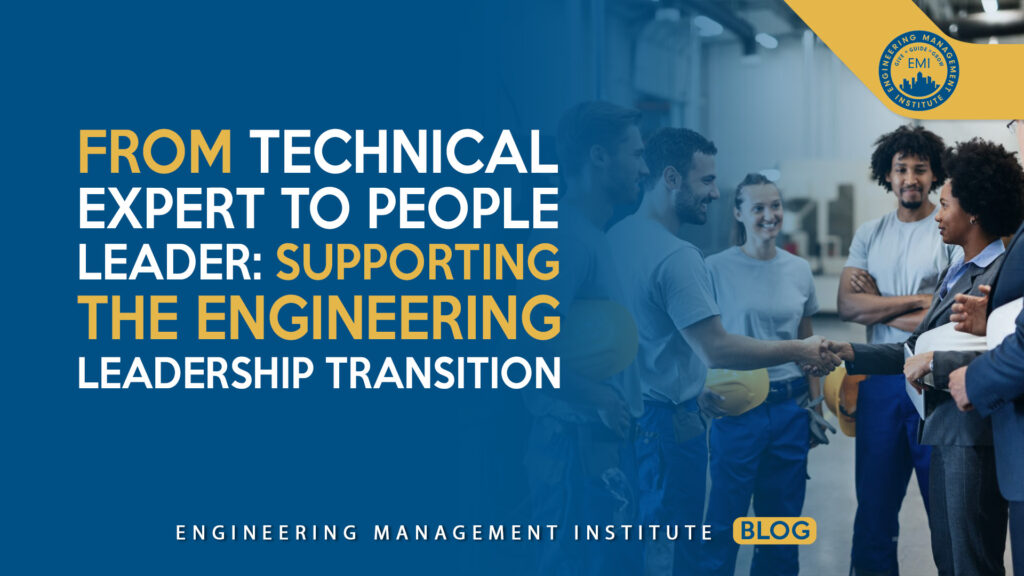

Engineering firms rely heavily on technical expertise. High performers are often promoted into leadership roles because of their deep knowledge, problem-solving ability, and project success. While this approach rewards performance, it also introduces a common challenge across the industry: technical excellence does not automatically translate into people leadership readiness.
For many engineers, the transition from technical expert to people leader is one of the most difficult shifts in their career. Without intentional support, organizations risk disengagement, poor team performance, and unnecessary turnover.
Common Challenges New Engineering Leaders Face
Engineers stepping into people leadership roles often encounter several obstacles at once:
- Shifting identity, moving from individual contributor to team leader
- Skill gaps, especially in communication, providing feedback, and delegation
- Role ambiguity, with unclear expectations for people leadership
- Time pressure, balancing technical and leadership responsibilities
Without guidance, many new leaders rely on trial and error, which can negatively impact both their confidence and their teams.
Understanding When Engineers Are Ready to Lead
Leadership readiness is not always visible through technical performance alone. An engineer may excel at solving complex problems yet struggle with communication, delegation, or managing team dynamics.
Before promoting engineers into people leadership roles, organizations benefit from taking a closer look at readiness indicators beyond project results. These may include how individuals collaborate with peers, respond to feedback, handle conflict, and communicate across various audiences.
By combining manager input, peer feedback, and clear leadership expectations, HR and engineering leaders can better identify when an engineer is prepared to take on people responsibilities and where additional support may be needed during the transition.
Practical Ways to Support Career Transitions
Supporting engineers through leadership transitions does not require complex or resource-heavy programs. What matters most is intentionality. When development is aligned with the realities of engineering work, even small efforts can have a significant impact.
Effective transition support often begins with leadership fundamentals training that builds clear communication, strengthens feedback skills, supports effective delegation, and emphasizes team development. These capabilities are rarely developed in technical roles, yet they are essential for anyone responsible for leading people.
Mentorship and coaching also play a critical role. Access to experienced people leaders who understand both the technical and human sides of leadership helps new leaders navigate challenges with confidence and perspective.
Many organizations find value in peer learning groups, where new or emerging leaders can share experiences, ask questions, and learn from one another. These environments normalize the learning curve and reduce the isolation that often accompanies leadership transitions.
Finally, successful transitions are supported through intentional pacing. Gradually shifting responsibilities, paired with regular check-ins during the first year, allows new leaders to develop skills while maintaining technical credibility and engagement.
When these approaches are applied together, engineers are better equipped to step into leadership roles with clarity, confidence, and long-term commitment.
Conclusion
The transition from technical expert to people leader is one of the most critical moments in an engineer’s career. When supported intentionally, it becomes an opportunity to strengthen leadership capability, improve retention, and elevate team performance. When overlooked, it can undermine even the strongest technical talent.
Supporting engineering leadership transitions does not have to be complicated. Even small, intentional actions can make a meaningful difference in how new leaders grow and succeed.
At EMI, we focus on helping engineering professionals and organizations develop strong, capable leaders through intentional learning and leadership development. If your organization is looking to better support engineers as they move into people leadership roles, our programs are designed to meet those needs.
About the Author:
 Alicia Peterson, MHR, SHRM-SCP, joined the Engineering Management Institute as the Human Resources Manager in July 2025. With over ten years of extensive experience in human resources and people operations, she brings expertise in a variety of disciplines, including employee engagement, organizational development, and leadership enablement.
Based in Oviedo, Florida, Alicia views HR as a consultative partner in the organization and strives to adapt HR practices that align with their business goals and long-term strategic initiatives. She holds a bachelor’s degree in management with a minor in human communications from the University of Central Florida, and a master’s degree in human resource management from Rollins College. Her work at EMI specifically aims to scale and streamline processes through periods of growth, build programs that represent EMI’s culture of “Give, Guide, Grow,” and support team members at all levels of the organization to achieve professional growth and satisfaction.


