

Most project managers in AEC firms learn project management the hard way. They get handed a job. They figure it out. Some do well. Some don’t. And the hope is that whatever lessons were learned last time somehow carry over to the next project.
For a lot of engineers who become PMs, that’s just how it goes.
But there’s a framework that, when understood and applied well, changes that dynamic entirely. The five project management process groups which were standardized by the Project Management Institute (PMI) — Initiating, Planning, Executing, Monitoring and Controlling, and Closing — aren’t just the backbone of the PMP credential. They’re a map for how successful projects actually move from idea to completion.
There are two challenges with the five process groups as standardized by PMI. One being that many PMs in the AEC industry haven’t heard of them. Some have. The challenge is that the day-to-day pressure of delivering projects makes it easy to skip steps, compress phases, and move fast in ways that cost you later. The second challenge is that PMI has standardized the process groups for ALL projects, however the verbiage and steps aren’t specific to AEC projects.
Let’s break down each process group — and where AEC project managers tend to show up well, and where they tend to struggle.
1. Initiating: Starting with Clarity
Every project starts with a decision. Is this the right project? Are we aligned on what success looks like? Who owns what?
The Initiating process group is about getting those answers before the work begins. It covers developing the project charter, identifying stakeholders, and establishing the authority and scope of the project from day one.
In AEC, this step gets rushed — or skipped entirely. Teams are eager to get into the field, into design, into execution. The work feels urgent. Getting started feels productive.
But unclear scope at the start almost always becomes a scope creep problem at the end. The client who wasn’t fully aligned in week one becomes the hardest conversation in month six.
Strong AEC PMs treat initiation as a critical decision point, not a formality. They slow down long enough to ask: do we actually have agreement here? And they document it.
2. Planning: The Work Before the Work
If initiation is about asking the right questions, planning is about building the road map to answer them.
PMI’s Planning process group is the most comprehensive of the five. It includes defining scope, creating the work breakdown structure, developing the project schedule, planning the budget, identifying risks, and setting up communication and procurement plans.
That’s a lot, and in AEC firms, it’s often where the biggest gaps live.
Technical work gets planned in detail. The engineering is scoped carefully, the drawings are sequenced, the QA process is defined. But the project management side of the plan — the risk register, the communication plan, the stakeholder engagement strategy — often gets a fraction of the same attention.
The result? Teams are technically strong and organizationally exposed. When a risk materializes that nobody planned for, or when a key stakeholder feels out of the loop, it’s usually a planning gap — not a technical one — that created the problem.
3. Executing: Leading While Doing
This is where most technical professionals feel at home. Things are happening. Work is underway. The plan is in motion.
The Executing process group is about directing and managing project work, managing quality, developing the team, managing communications, and engaging stakeholders as the project unfolds.
Here’s where the transition from engineer to project manager gets real.
Most engineers become PMs because they were great at technical work. But execution-phase project management requires a different skill set — team leadership, conflict resolution, quality assurance, client communication. These don’t come automatically with technical expertise. For a lot of PMs, this is where they feel most stretched.
The technical side of execution? They’ve got it. The people side — navigating a difficult conversation with a subcontractor, keeping a client informed through an unexpected change, building a team that actually functions well under pressure — that’s the work that takes intentional development.
4. Monitoring and Controlling: Staying Connected to Reality
A plan without monitoring is just a wish.
The Monitoring and Controlling process group runs parallel to execution. It covers tracking project performance, managing changes, validating and controlling scope, monitoring risks, and measuring progress against the original plan.
In AEC, this is where write-offs happen.
When teams aren’t tracking earned value, aren’t flagging scope changes in real time, or aren’t communicating budget status accurately, small problems compound into project losses. A 2% budget variance at week four can become a 15% write-off by project close if nobody’s watching.
The PMs who excel here aren’t necessarily the ones with the most complex tracking systems. They’re the ones who stay connected to project reality — who have honest conversations early, who flag problems before they become crises, and who treat monitoring as an ongoing habit rather than a monthly report.
5. Closing: Finishing Well
The Closing process group doesn’t get enough attention.
Closing involves formally completing the project, getting client acceptance, releasing resources, archiving records, and capturing lessons learned. Done well, it sets the firm up for stronger performance on the next project. Done poorly — or skipped — the same mistakes keep showing up.
In AEC, projects often “end” when the deliverable ships. The team moves on. The next job starts. Close-out becomes an afterthought, and lessons learned either don’t happen or produce a document nobody reads.
That’s a real loss. The firms that build a genuine project close-out process — where teams actually reflect on what worked and what didn’t — are the ones where PMs improve fastest. Not because they’re more talented, but because they’ve built a system for learning.
Why This Framework Matters
The five process groups aren’t a rigid checklist. Real projects don’t move in a perfect linear sequence. You revisit planning during execution. Monitoring informs decisions all the way back to scope. Initiating a project change mid-stream looks a lot like starting over.
But the framework gives PMs a language and a structure for thinking about where they are in a project — and what the work actually requires of them at that specific moment.
For AEC professionals navigating complex projects with long timelines, multiple stakeholders, and significant financial stakes, that kind of clarity matters.
The question isn’t whether these process groups apply to your work. They do.
The question is: which ones are you showing up in most consistently — and which ones deserve more of your attention?
If your PMs are figuring out project management on their own — rushing through initiation, skipping the planning fundamentals, or losing track during execution — there’s a better way.
EMI works with AEC firms to build custom PM development programs that address these exact gaps, grounded in research and built for lasting skill transfer.
Book a call to talk through what a development program could look like for your team.
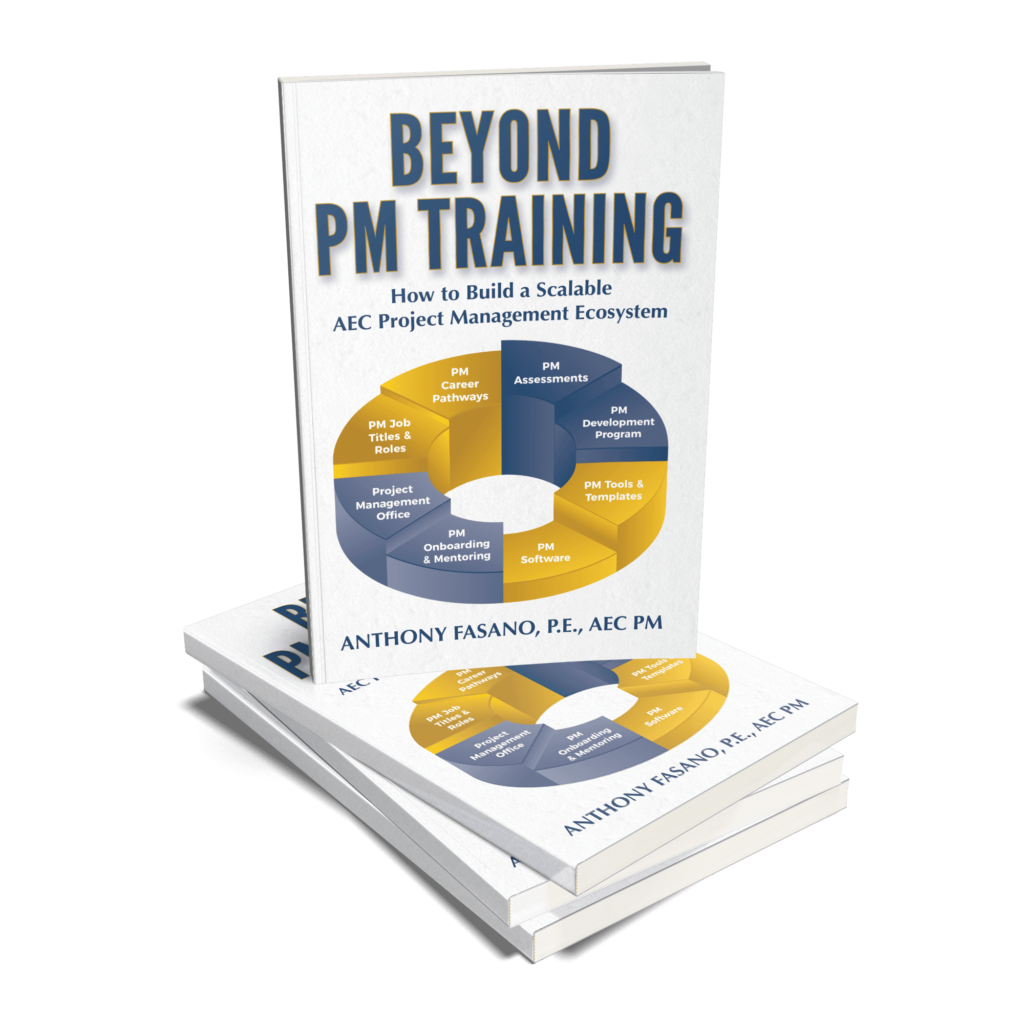
Request a complimentary copy of Beyond PM Training: How to Build a Scalable AEC Project Management Ecosystem


